Cheat Features Glossary: Aimbot, ESP, Wallhack and Other Terms Explained
A plain-English glossary of cheat features: aimbot, ESP, wallhack, radar and more. What each term means before you buy.
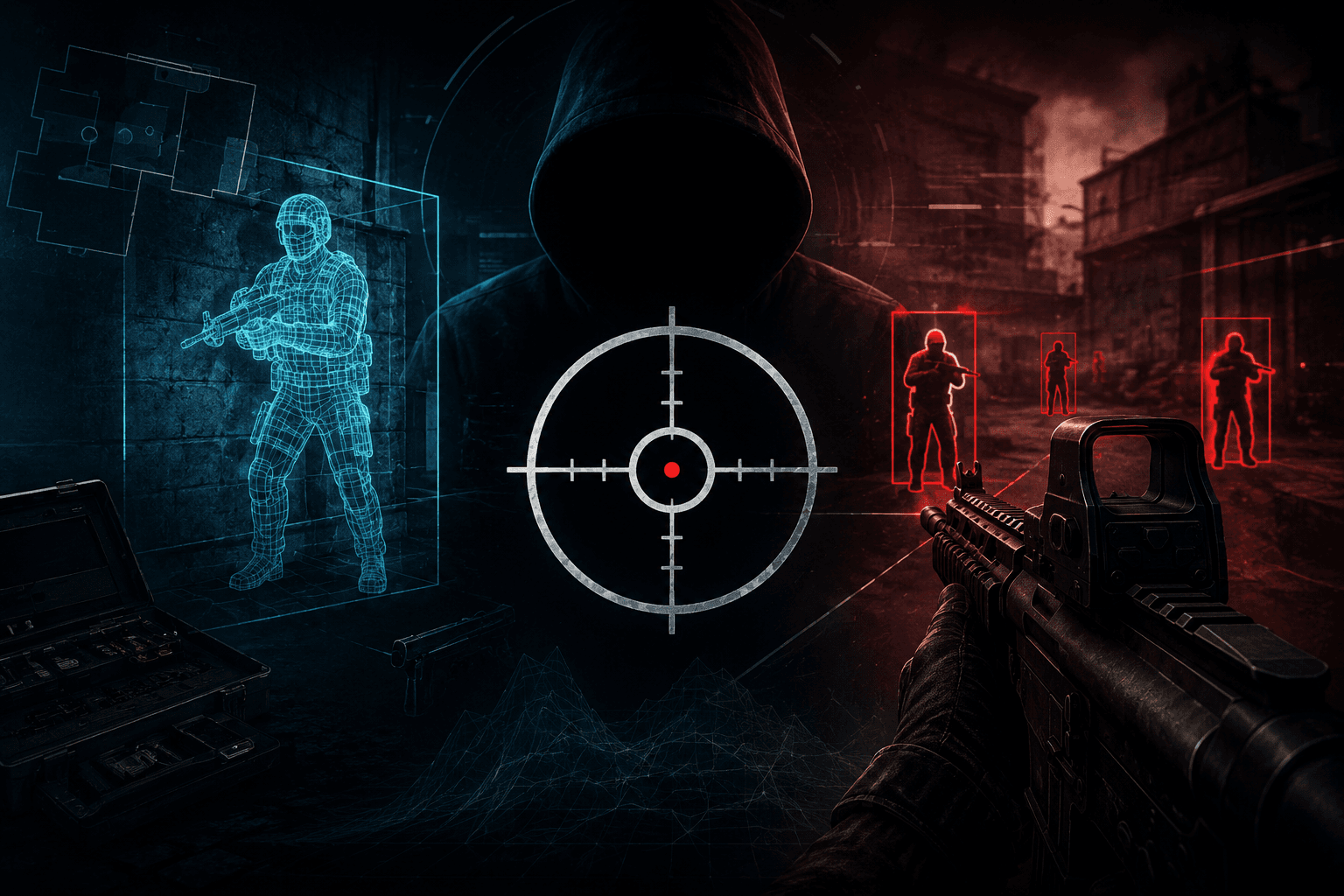
Every product page in this niche is full of terms that mean nothing until someone explains them. Aimbot, ESP, wallhack, radar, internal, external, DMA: sellers use these words constantly, sometimes interchangeably, even though they describe genuinely different pieces of software with different price tags and different risk profiles. This glossary walks through the terms you'll run into most often on cheat product pages, so a description full of buzzwords turns into something you can actually compare.
ESP vs Wallhack: What's the Actual Difference
ESP stands for Extra Sensory Perception. It's an overlay drawn on top of the game that shows information you wouldn't normally have access to: where other players are, what they're carrying, how much health they have, how far away they stand. The game itself already tracks all of this data for rendering and physics purposes. ESP just reads it and displays it back to you, box by box, name by name.
Wallhack is a narrower, older term. Strictly speaking, it refers to making walls and other solid geometry transparent or see-through, either by editing how textures render or by disabling depth checks. In casual use, sellers often say "ESP" and "wallhack" as if they're the same thing, and functionally the end result looks similar, since you can see enemies through walls either way. The distinction matters mainly when you're comparing feature lists: an ESP overlay tends to be cleaner and more configurable, while a true wallhack changes the geometry itself.
Common ESP variants you'll see listed
Box ESP: a 2D or 3D frame drawn around each player's model.
Skeleton ESP: shows the player's bone structure, useful for reading movement and peek angles.
Item ESP: highlights loot, weapons and attachments through walls, common in extraction shooters.
Chams: recolors player models so they stand out against the environment, sometimes visible through geometry.
Aimbot and Triggerbot: Automated Aiming Explained
Aimbot automatically moves your crosshair toward a target. On its own that description undersells how configurable it usually is, since most products let you tune exactly how it behaves rather than snapping instantly to a head.
FOV (field of view): the radius around your crosshair where the aimbot is allowed to lock onto a target. Smaller FOV looks more natural.
Smooth: how gradually the crosshair moves onto the target instead of snapping. Higher smooth mimics human mouse movement.
Bone selection: which part of the model to aim at, such as the head, chest, neck, or the nearest visible bone.
Visible check: restricts aiming to targets you could actually see, so it won't lock through a solid wall.
Triggerbot is narrower: it doesn't move your aim at all, it just fires automatically the instant your crosshair happens to be over an enemy. Because you're still doing the actual aiming, it reads as less mechanical than a full aimbot, though a suspiciously fast, consistent reaction time is still something anti-cheat behavioral analysis looks for.
Radar, No Recoil and Other Common Add-Ons
Radar (sometimes called an overlay radar or 2D radar) shows enemy positions on a separate map or minimap, including players who are out of sight or behind you. It's a purely informational feature. It doesn't touch your aim or your weapon, which is part of why some players consider it a softer form of cheating than aimbot.
No recoil / no spread removes or reduces the weapon's natural kick pattern, so every shot lands closer to where you originally aimed. It's often bundled with aimbot rather than sold separately.
You'll also see references to legit mode versus rage mode. These aren't separate products, they're configuration presets. Legit mode dials settings down (small FOV, high smooth, ESP kept subtle or off) to look like a skilled human. Rage mode maxes everything out for a blatant, obvious advantage. The trade-off is straightforward: legit settings are slower to draw attention, rage settings are faster to get flagged.
Internal, External and DMA: How a Cheat Is Delivered
These terms describe where the cheat's code actually runs, and it's one of the bigger factors in both price and detection risk.
Internal: the cheat is injected directly into the game's own process. It gets deep access and can support more features, but living inside the game's memory space is exactly where in-process anti-cheat scans look first.
External: the cheat runs as a separate program and reads the game's memory from outside its process. It's harder for scans that only inspect the game process itself to catch, though it's not invisible to system-wide monitoring.
DMA (Direct Memory Access): a physical PCIe card, usually installed in a second computer, reads the target PC's memory over a hardware connection. No cheat software ever runs on the gaming PC itself, which is why DMA setups are the hardest of the three to detect, at the cost of needing extra hardware and a second machine.
Detected vs Undetected (UD): Reading a Product's Status
"Detected" means the anti-cheat currently protecting a game can identify that specific cheat, which risks an immediate ban or a ban applied later in a batch (see our guide on ban waves and detection). "Undetected", shortened to UD, means the opposite: as far as current testing shows, the anti-cheat doesn't flag it. Status isn't permanent in either direction: a UD product can get flagged after an anti-cheat update, and a previously detected one can return to UD once the developer ships a fix. This is exactly why serious sellers publish a live status page instead of a one-time claim on the product listing, so check it before every session, not just before you buy.
FAQ
Are ESP and wallhack the same thing?
They're closely related and often used interchangeably by sellers. Technically, ESP is an information overlay drawn on top of the game, while wallhack refers to altering how walls render so you can see through them directly. In practice, most modern products bundle both under one "ESP" feature.
Is a triggerbot less risky than a full aimbot?
It tends to look less mechanical since it doesn't move your crosshair, but consistently inhuman reaction times are still something behavioral detection watches for. Neither feature is inherently safe, it comes down to how the specific product is built and configured.
Do I need extra hardware to use any of these features?
No. Internal and external cheats run entirely in software on your gaming PC. Only DMA setups require a physical PCIe capture card and typically a second computer.
What does it mean if a product page says "UD"?
It means the cheat is currently passing detection in testing. It's a snapshot, not a guarantee, so always check a seller's live status page close to when you're actually playing.
Should I use legit mode or rage mode settings?
Legit settings (tight FOV, high smooth, subtle ESP) are built to look like normal skilled play and draw less attention over time. Rage settings prioritize raw effectiveness over how it looks, which is a trade-off worth understanding before you touch the configuration.
Understanding these terms turns a product page into something you can actually compare rather than a wall of marketing language. If a listing mentions a feature you're not sure about, check the glossary again before assuming what it does. The exact configuration usually matters more than the label.